Pricing Is the Highest-Leverage Decision You'll Make
A $5 change in ticket price, multiplied across 10,000 tickets sold, is $50,000 in revenue. Pricing tends to get less strategic attention than lineup, marketing, or production, but it moves the bottom line more than any of those individually. Events that price well capture the revenue their demand is willing to give them. Events that don't leave meaningful money on the table at both ends: underpriced early, overpriced late, or priced flat when dynamic pricing would have captured more.
This guide covers ticket pricing end to end: the break-even math you need to ground your floor price, the tier architecture that captures the full range of willingness to pay, the dynamic pricing mechanics that outperform static pricing in nearly every scenario, and the psychological and operational refinements that separate good pricing from great pricing.
Start with the Correct Break-Even Formula
Break-even is the ticket price at which total ticket revenue exactly covers total event costs. It's your floor, not your target, but you can't set a target without knowing your floor.
The correct formula:
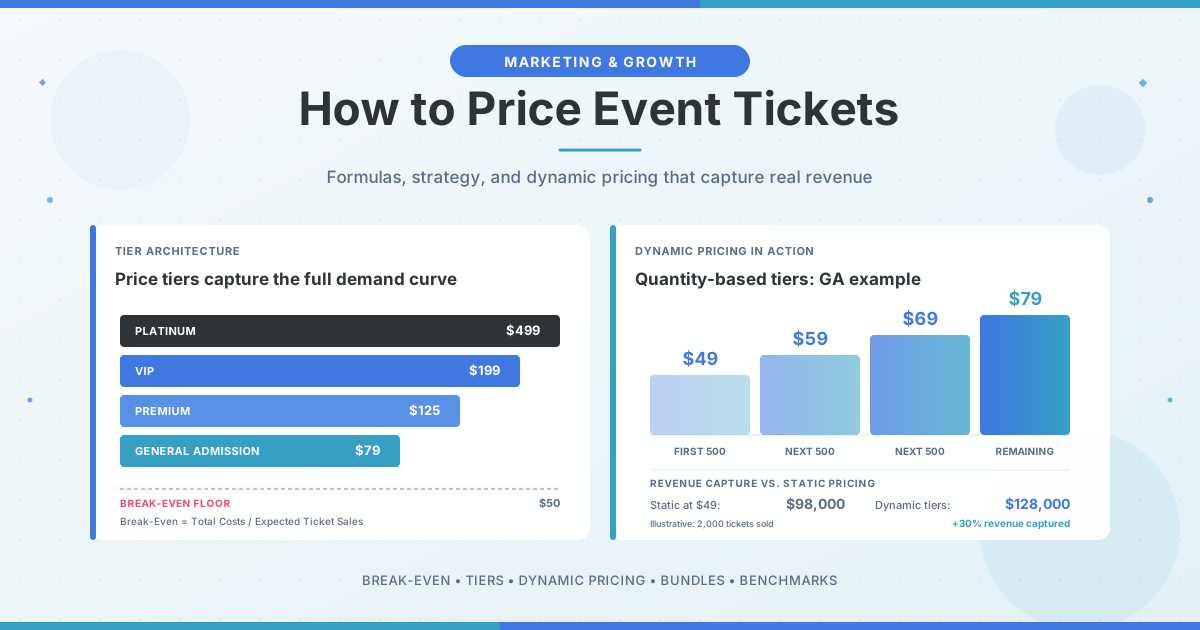
Break-Even Ticket Price = Total Event Costs ÷ Expected Ticket Sales
If your total event costs are $200,000 and you realistically expect to sell 4,000 tickets, your break-even price is $50 per ticket. Selling at $50, you cover costs. Selling below $50, you lose money. Selling above $50, you generate profit on each additional ticket.
Three refinements most organizers skip:
- Separate fixed costs from variable costs. Venue rental, talent fees, insurance, permits, and marketing are fixed costs (they don't change based on attendance). Variable costs include per-attendee items like wristbands, printed materials, and catering. Knowing your fixed-vs-variable split tells you how much margin each additional ticket actually generates.
- Account for payment processing and platform fees. If you absorb fees rather than passing them to the buyer, include them in your cost side. For Big Tickets organizers, pricing is transparent; see the pricing page for the full breakdown.
- Pad your estimate conservatively. First-year events almost always underestimate costs and overestimate ticket sales. Build in a 10–20% buffer on costs and a 10–20% reduction on expected sales to get a realistic break-even.
Your break-even price isn't what you charge. It's the number that tells you how much cushion you have before a price change puts the event underwater.
Forecast Demand Honestly, Not Optimistically
The most common pricing mistake isn't a math mistake, it's a forecasting mistake. Organizers set prices based on the attendance they hope to hit, not the attendance they're actually likely to produce. The result is either underpriced tickets that sell out without capturing full value, or overpriced tickets that don't sell at all.
Signals that actually predict ticket sales:
- Previous year's sales at this point in the cycle. If you had 2,400 tickets sold six weeks out last year and you're at 1,800 this year, you're tracking 25% behind. That's the honest forecast, not last year's final number.
- Email list growth and engagement rate. A larger, more engaged list usually predicts stronger on-sale performance. A shrinking list is a leading indicator even if other signals look neutral.
- Competitor and adjacent event performance. If similar events in your region are selling slower than usual, broader market softness is probably affecting you too.
- Presale indicator demand. How quickly did VIP and early-bird tiers move? Strong early tier sell-through is a reliable leading indicator for general admission.
Base your pricing on the honest forecast. If the honest number is lower than you'd like, that's a marketing problem to solve, not a pricing number to inflate.
Design a Tier Architecture, Not a Single Price
A single-price ticket is a revenue ceiling. You'll either underprice your most enthusiastic buyers (who would have paid more for better access) or overprice your most price-sensitive buyers (who would have come at a discount). Tiered pricing captures both ends of that range.
A well-designed tier architecture includes three to five price points, each tied to a real difference in attendee experience:
- General Admission (GA). Your volume tier. Priced above break-even, close to market norms, designed to move large quantities.
- Premium or Reserved. For events with reserved seating, better locations command higher prices. For GA festivals, this might be a raised viewing area, dedicated entry lane, or early entry window.
- VIP. Typically 2–3× GA pricing. Includes meaningful differentiation: dedicated bars, private restrooms, viewing decks, artist meet-and-greets, comfortable seating, expedited entry.
- Platinum or Ultra-VIP (optional). For events with a clear premium audience, a top tier priced 5–10× GA captures buyers who want the highest-value experience. Even a small number of platinum ticket sales significantly increases overall revenue.
- Group or Payment Plan options. Group tickets (4+) often work with a slight per-ticket discount that drives larger orders and reduces CAC. Payment plan options (through PayPal Pay Later at checkout on Big Tickets) make higher-tier tickets more accessible to buyers who can't pay the full amount up front.
The trick isn't adding more tiers; it's making sure each tier represents enough value differentiation that buyers can see why it costs more. A VIP ticket that only includes "a wristband" doesn't justify a 3× price. A VIP ticket that includes dedicated bars, seating, and entry saves buyers 45 minutes in the heat and earns the markup.
Use Dynamic Pricing to Capture More of the Demand Curve
Static pricing (a single price that stays constant from on-sale to event day) is a holdover from the paper-ticket era. Modern ticketing platforms let you run pricing that changes based on either quantity sold or date. Both approaches capture revenue that static pricing leaves behind.
Big Tickets supports both mechanisms, and they can be layered:
- Quantity-based pricing. Price steps up as inventory sells. Classic structure: first 500 tickets at $49, next 500 at $59, next 500 at $69, remaining at $79. Buyers see a real "X tickets left at this price" signal, which creates urgency without artificial scarcity. Early buyers are rewarded for committing; later buyers pay the premium for waiting.
- Date-based pricing. Price steps up at scheduled times. Classic early-bird structure: $49 through March 1, $59 through April 1, $69 through May 1, $79 from there until event day. Simpler to explain, easier to market (clear deadlines make for clear email subjects).
Which approach works better depends on the event. Quantity-based pricing tends to work better when demand is uncertain; you capture more revenue as the event sells, without having to commit to prices in advance. Date-based pricing works better when the buying cycle is predictable and you want firm deadlines for urgency-driven marketing.
For most festivals and live events, a layered approach captures the most revenue: quantity-based tiers inside of date-based windows. Early-bird tier (date-capped) with quantity-based micro-tiers inside it that escalate as the early-bird inventory sells. This is more complex to configure, but the revenue capture is meaningfully higher than either approach alone.
Since Big Tickets doesn't currently offer native side-by-side A/B testing for pricing, scheduled tiers effectively serve the same purpose over time: you observe sell-through at each price point and adjust your next event's pricing based on what actually performed. The tiers are your test, the data is your read, and next year's pricing is the change.
Benchmarking: Price Against Reality, Not Assumption
Setting prices in a vacuum is how organizers end up 30% off the market. You need reference points, but the right reference points aren't "whatever feels fair." They're based on comparable events, comparable tiers, and comparable buyer profiles.
How to benchmark well:
- Same-category events in your region. A music festival in Atlanta should benchmark against other music festivals in the Southeast, not against corporate conferences or against music festivals in LA.
- Same tier structure. If you're pricing a VIP ticket, compare to VIP tickets at similar events, not to GA. A $200 VIP ticket looks expensive next to $75 GA, but reasonable next to comparable VIPs at $180–$250.
- Same event size. A 50,000-person festival can support different pricing than a 2,000-person event, even with similar programming. Event scale directly affects per-attendee economics.
- Your own historical data. If your GA sold out in three weeks last year at $65, this year's GA should probably be $70–$75. The market told you what your event is worth.
Big Tickets provides detailed benchmarking reports to organizers, so you can see how your pricing, sell-through, and revenue performance compares to comparable events on the platform. This is a real advantage over pricing in isolation, and it's data most ticketing platforms don't share with organizers at all.
Psychological Pricing: Small Decisions That Compound
The specific number you choose matters beyond the accounting. Buyers process prices visually and emotionally as much as rationally, and small adjustments to how a price is displayed can meaningfully affect conversion.
Principles that consistently move the needle:
- Charm pricing. $49 consistently outperforms $50 for consumer-facing tickets, even though the real difference is trivial. Buyers process the leftmost digit first, and $49 reads as "in the 40s" while $50 reads as "in the 50s." Use rounded pricing ($50, $100, $250) when you're positioning a ticket as premium; use charm pricing when you're positioning it as accessible.
- Price anchoring. Showing a premium tier alongside GA makes the GA price look more reasonable by comparison. A $500 VIP ticket next to $75 GA makes $75 feel like the deal, not the expense. Even if your VIP inventory is small, its existence anchors the entire price structure.
- Fee transparency. Hidden fees at the final checkout step are one of the most destructive things you can do to conversion. Buyers who see $49 and land on a $67.50 checkout abandon at high rates. Big Tickets lets organizers choose whether to absorb fees or pass them to buyers; either option is fine, but show the full price up front either way.
- Limit the price floor. Too-low pricing signals low value. If your comparable events are priced at $60–$80 and you price at $25, buyers often read the gap as "something is wrong with this event" rather than "what a deal." Don't underprice as a marketing tactic; low prices rarely drive proportional volume increases on higher-quality events.
Bundles: Price Multiple Items as One Decision
Bundles are a pricing strategy disguised as a convenience feature. When you sell a ticket plus parking plus a drink credit as a single item, you raise your average order value (AOV), reduce checkout friction, and capture revenue from add-ons that many buyers would skip if offered separately.
Bundle structures that work for live events:
- Ticket + parking. Huge AOV lift for events where parking is a real consideration.
- Ticket + merchandise. T-shirt or limited merchandise bundled at checkout converts much higher than merch sold separately on an upsell screen.
- Ticket + food and beverage credits. Pre-sold F&B revenue is guaranteed revenue that also moves more concession volume on event day.
- Multi-day passes. Discounted multi-day bundles versus single-day tickets drive attendees to commit to the full event, which improves retention, on-site spend, and next-year repeat rates.
- Group packages. Four tickets at a slight per-ticket discount. Increases order size and reduces CAC on each attendee.
Big Tickets supports ticket and add-on bundles natively, so buyers see a single item in checkout rather than piecing together separate purchases. The operational benefit is clean reporting; the commercial benefit is higher AOV with less friction.
Common Pricing Mistakes to Avoid
A few consistent mistakes worth naming:
- Setting the price once and never revisiting. Pricing is not a one-time decision. Review your pricing structure every cycle based on sell-through data, buyer feedback, and market conditions.
- Pricing based on cost-plus only. Cost-plus gives you a floor, not a ceiling. Price against what the market values your event at, then check that the floor works.
- Ignoring sell-through velocity. If your VIP tier sold out in 24 hours, you priced it too low. If GA is lagging six weeks before the event, something is off. Pay attention and adjust.
- Adding tiers that don't differentiate. Three tiers with meaningful value differences outperform seven tiers that only differ by $5. Buyers make clearer decisions with simpler ladders.
- Discount fatigue. If your audience learns that prices always drop in the final week, they'll wait. Early-bird discounts work when they clearly close and prices actually rise; they fail when they become a perpetual "the sale never ends" pattern.
Pricing Is an Operating Rhythm, Not a Launch Decision
The organizers who price best don't set a number once and hope. They anchor in break-even math, design a tier architecture that matches their audience, use dynamic pricing to capture more of the demand curve, benchmark honestly against comparable events, and then watch the data and adjust each cycle.
For a broader look at how pricing fits into your full ticket sales strategy, see our guide to boosting ticket sales. For a look at how to measure whether any of this is actually working, see how to measure event marketing ROI. Pricing doesn't stand alone. It's one lever among several, and the best results come from pulling them together.
Ready to Run a Smarter Event?
Big Tickets helps festivals, fairs, concerts, and live events sell more tickets, streamline operations, and deliver a better attendee experience. No subscriptions, no setup fees.
Request a Demo